
Electronics and Communication Engineering
- Home
- Electronics and Communication Engineering
- About Department
- Vision, Mission, PEOs
- POs, PSOs
- Faculty
- Laboratory
- Placement
- Research
- Events Organized
- Curriculum & Syllabus
- Video Lecturing
- Activity Based Learning
- MoU
- Industry Interaction
- Value Added Courses
- News Magazine
- Contact Us
Department of Electronics & Communication Engineering
About Department
The Department of Electronics and Communication Engineering was established in the year 2008 with an intake of 60 students. Our mission is to provide quality education to students and instill excellence in the field of Electronics and Communication. The post graduate program in the specialization of VLSI Design was established in the year of 2012 with an intake of 18 students. The undergraduate and post graduate programmes of the department of Electronics and Communication impart solid technical background and research capabilities among the students which help them to excel in their respective fields. We provide students with easy-to-access information, accelerated learning, and opportunities to apply their knowledge. The department, headed by Professors, Associate Professors and Assistant Professors who are experts in their own disciplines, aims at educating and training students with sound knowledge and awareness in the latest trends in electronics, communication and information technology.
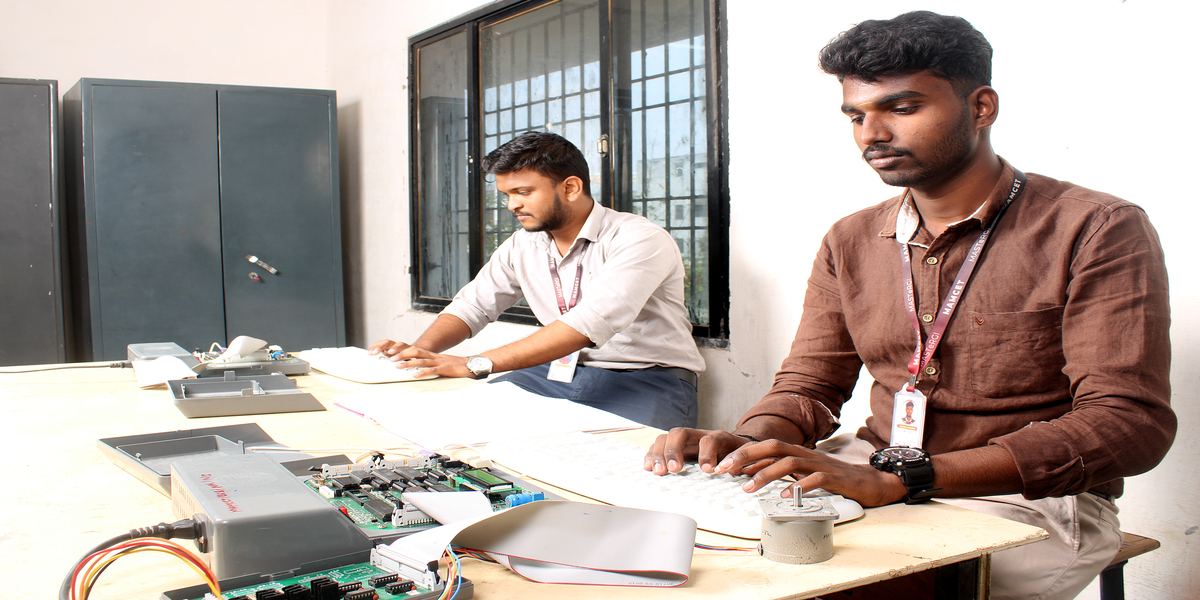
The state-of-the-art laboratories complement the high standards set by the competitive syllabus and nurture the inclination of the students towards research and development, besides giving them the necessary and sufficient backing of practical knowledge that they need. The department has established Anna University recognized research centre in the year of 2021. As a testament to our commitment to excellence, we maintain professional memberships with esteemed societies such as IEI, IETE and PALS. We have signed MOUs with various reputed industries and with that relationship to enhance the practical exposure of our students.Through these collaborations, we organize numerous activities, including guest lectures, workshops, skill development programs, value-added courses, and industrial visits. Our students also benefit from internships with renowned companies, contributing to a consistent placement record of above 85% each year.
Vision and Mission
Vision
To be a leading department that promotes excellence in electronics and communication engineering, research, and innovation, instilling ethical values and social responsibility in our graduates.
Mission
M1: To provide a comprehensive education that prepares students for successful careers in Electronics and Communication Engineering, with a strong emphasis on theoretical knowledge and practical skills.
M2: To foster a culture of research and innovation in Electronics and Communication Engineering, encouraging students and faculty to pursue cutting-edge technologies.
M3: To collaborate with industry partners and leading organizations to provide practical experience for students in Electronics and Communication Engineering, preparing them for real-world challenges.
M4: To promote ethical behavior and social responsibility among our community of Electronics and Communication Engineering students, with a focus on environmental sustainability and social impact.
M5: To empower strong communication and leadership skills among our Electronics and Communication Engineering students through open collaboration, teamwork, and professional development opportunities.
Programme Educational Objectives (PEOs)
PEO1: To equip graduates with a strong foundation in theoretical knowledge and practical skills in Electronics and Communication Engineering, enabling them to succeed in their careers.
PEO2: To develop graduates’ research and innovation skills in Electronics and Communication Engineering, enabling them to contribute to cutting-edge technologies.
PEO3: To prepare graduates for real-world challenges in Electronics and Communication Engineering by providing practical experience through collaborations with industry partners and leading organizations.
PEO4: To instil ethical behaviour and social responsibility in graduates, with a focus on environmental sustainability, and social impact, enabling them to contribute to a better society as Electronics and Communication Engineers.
PROGRAM OUTCOMES (POs)
-
Engineering Graduates will be able to
-
PO 1 Engineering Knowledge: Apply the knowledge of mathematics, science, engineering Fundamentals, and an engineering specialization to the solution of complex engineering problems
-
PO 2 Problem Analysis: Identify, formulate, review research literature, and analyze complex engineering problems reaching substantiated conclusions using first principles of mathematics, natural sciences, and engineering sciences.
-
PO 3 Design/ Development of Solutions: Identify, formulate, review research literature, and analyze complex engineering problems reaching substantiated conclusions using first principles of mathematics, natural sciences, and engineering sciences.
-
PO 4 Conduct Investigations of Complex Problems: Use research-based knowledge and research methods including design of experiments, analysis and interpretation of data, and synthesis of the information to provide valid conclusions
-
PO 5 Modern Tool Usage: Create, select, and apply appropriate techniques, resources, and modern engineering and IT tools including prediction and modelling to complex engineering activities with an understanding of the limitations.
-
PO 6 The Engineer and Society: Apply reasoning informed by the contextual knowledge to assess societal, health, safety, legal and cultural issues and the consequent responsibilities relevant to the professional engineering practice.
-
PO 7 Environment and Sustainability: Understand the impact of the professional engineering solutions in societal and environmental contexts, and demonstrate the knowledge of, and need for sustainable development.
-
PO 8 Ethics: Apply ethical principles and commit to professional ethics and responsibilities and norms of the engineering practice.
-
PO 9 Individual and Team Work: Function effectively as an individual, and as a member or leader in diverse teams, and in multidisciplinary settings.
-
PO 10 Communication: Communicate effectively on complex engineering activities with the engineering community and with society at large, such as, being able to comprehend and write effective reports and design documentation, make effective presentations, and give and receive clear instructions.
-
PO 11 Project Management and Finance: Demonstrate knowledge and understanding of the engineering and management principles and apply these to one’s own work, as a member and leader in a team, to manage projects and in multidisciplinary environments.
-
PO 12 Life-long learning: Recognize the need for, and have the preparation and ability to engage in independent and life-long learning in the broadest context of technological change.
PROGRAM SPECIFIC OUTCOMES(PSOs)
-
Apply the fundamental principles of Science, Mathematics and Engineering to design and develop semiconductor technologies, high speed communication and Sensor based embedded systems.
-
Analyse and Optimize the performance of Electronic Design System, Signal Processing, Communication System and Networks using appropriate tools, techniques and software.
| Sl. No | Name | Designation |
|---|---|---|
| 1 | Dr. X. Susan Christina | Principal |
| 2 | Dr. G. Haridoss | Asso. Prof. & HoD |
| 3 | Mr. M. Syed Abdul Salam | Assistant Professor |
| 4 | Mrs. S. Kavitha | Assistant Professor |
| 5 | Mrs. S. Jayaseeli | Teaching Assistant |
| 6 | Mrs. Hemalatha Balakrishnan | Assistant Professor |
| 7 | Mrs. P. Delphine Mary | Assistant Professor |
| 8 | Mrs. R. Jayashalini | Assistant Professor |
| 9 | Mrs. N. Gayathri | Assistant Professor |
| 10 | Dr. E. Vinodha | Assistant Professor |
| 11 | Mrs. K. Priyadharshini | Assistant Professor |
| 12 | Mrs. M. Gajapriya | Assistant Professor |
Laboratory Specification
LIST OF MAJOR EQUIPMENTS
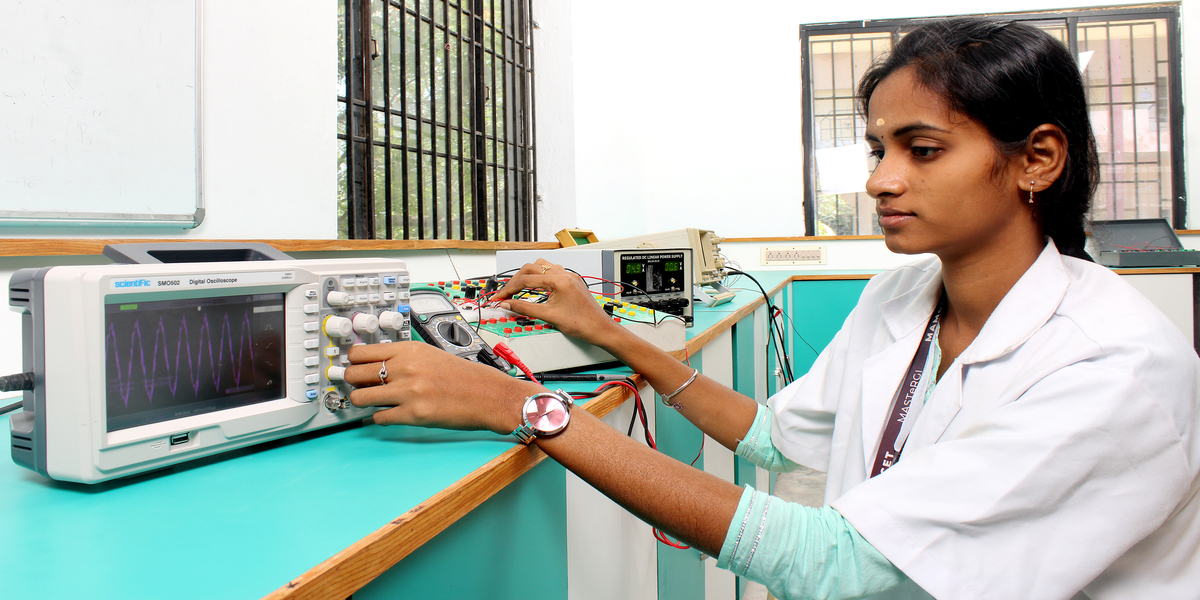
1. Digital Storage Oscilloscope
2. Cathode Ray Oscilloscope
3. Power Supply
4.Function Generator
5. Personal Computers
LIST OF MAJOR EQUIPMENTS
1. Cathode Ray Oscilloscope
2. Digital Storage Oscilloscope
3. Function Generator
4. Regulated Power Supply
5. Analog and Digital IC Tester
6. IC Trainer Kit
1.Function Generator
2.Cathode Ray Oscilloscope
3.Digital Signal Processor Trainer Kit
4. Stepper Motor
5. Personal Computers
6. Analog Discovery Kit
7. LAN –T Trainer Kit
8. W-LAN Wireless Ethernet LAN Trainer Kit
LIST OF MAJOR EQUIPMENTS
1. Spartan-3 Trainer Kit
2. Spartan-6 Trainer kit
3. Altera FPGA Kit
4. Personal Computers
5. ARM Evaluation Board
6. ARM-7 LPC2148 Kit
7. Zigbee Wireless Module
8. FPGA Daughter Card
LIST OF MAJOR EQUIPMENTS
1.8085 Kit
2.8086 Kit
3.8051 Microcontroller
4. Stepper Motor kit with Motor
5. DC Motor Interface Kit
6. Traffic light controller kit
7. Mixed Signal Oscilloscope
8. X Band Microwave Test Bench
9.X Band Horn Antenna Radiation Pattern Set up
LIST OF MAJOR EQUIPMENTS
1. My DAQ, My RIO
2. Tanner
3. Arduino and its Supporting Accessories
PLACEMENT DATA
Research
The Research and Development (R&D) department focuses on helping people explore new and challenging areas in Electronics and Communication. Teachers and students work together on projects that solve real problems, benefiting society. This improves everyone’s research skills by obtaining funds for projects, writing papers, and participating in events like conferences and workshops.
Objective
- To engender awareness, furnish opportunities, and cultivate a dynamic atmosphere for Research and Development among faculty and students within the department.
Outcome
- To create inventive resolutions.
- To enhance research endeavours leading to publications in esteemed journals and conferences.
- To encourage cooperation with industry partners, fellow academic institutions, and research organizations.
- To acquire financial support from external sources such as grants and sponsorships to back additional research initiatives.
Student Project Involvement
- To motivate the students to apply for funding to conduct research and start-ups through the student project scheme with various funding agencies such as TNSCST, MSME, IEI, DRDO, etc.
- To promote the creation of initiatives aimed at attracting the most research-oriented students.
Project Proposal using R&D Lab:
Assigning experienced faculty members to different research organizations to secure collaborative projects and implement effective methods
- To support in applying for and securing funds to conduct seminars, workshops, and faculty development programs from multiple funding agencies.
- To promote the expansion of research endeavours within the academic community, which involves devising strategies and goals to accomplish this objective.
Research Activity:
- To create and organize plans aimed at optimizing the faculty’s achievement in securing external research funding, as well as conducting workshops and staff development initiatives focused on research-related matters at the faculty level.
- To uphold and distribute up-to-date information concerning pertinent research policy domains and initiatives within government, professions, and relevant industries, which encompasses opportunities for external funding.
- To formulate tactics for nurturing research partnerships within the faculty, spanning across faculties and institutes, as well as engaging with external agencies beyond the college.
- To collaborate with different departments to set and enhance faculty research priorities in interdisciplinary domains.
- To instill a culture among staff members to engage in research projects and enhance their expertise, capabilities, and qualifications by pursuing Ph.D studies.
- To motivate both staff members and students to submit technical papers for publication in respected national and international conferences/journals.
- To engage in research endeavours and development projects provided by agencies.
To aid in the application process and securing funds to conduct seminars, workshops, and faculty development programs from multiple available funding sources.
[ninja_tables id=”7349″]
[ninja_tables id=”7350″]
[ninja_tables id=”7352″]
Events
Memorandum of Understanding (MOU)
Industry interaction leads to the establishment of industry supported laboratory in the institution. The industry supported laboratories develop best learning process using a comprehensive understanding of industry’s best practices for both students and faculties and enrich the student’s technical skills in latest technologies.
Industry supported Laboratories
Sl.No |
Name of the Industry |
Name of the laboratory |
Year |
|---|---|---|---|
|
1 |
Jet Aerospace – IHFCT Innovation hub of IIT, Delhi |
Drone |
2023 |
|
2 |
Maven Silicon Softech |
VLSI |
2022 |
|
3 |
National Instruments |
LabView |
2021 |
Industry Interaction
Internship Details
S.No | Name of the Company | Internship Details | Number of Students Participated |
1 | Test base solution Engineering private limited | Software trainee | 2 |
2 | Carwale Technology, Bangalore | Java Developer | 1 |
3 | SHS Advisory Group | Web designer | 1 |
4 | E Quadriga Software Trichy | Trainee Web developer | 2 |
5 | Mr. Cooper , Chennai | Trainee Web developer | 2 |
6 | IIEC, Chennai | Digital Marketing | 3 |
7 | Power integrated solutions, Tennur, Trichy | PCB Designer | 9 |
8 | SAMCORE Solutions | IoT | 18 |
9 | WITSPIRE Solutions | Full Stack | 6 |
10 | Sky Rider Institutions | Developer | 1 |
11 | Pantech Solutions | Web Designing | 3 |
12 | CodeBind | with HTML and CSS | 3 |
13 | Dynamic panels and controls private limited, Chennai | Python Programmer | 4 |
14 | Tele-global network enterprises,Chennai | Intern | 1 |
15 | Marcello Tech Trichy | Intern | 1 |
16 | Power integrated solutions, Tennur,Trichy | Intern | 3 |
17 | Twin health, IITM Chennai | Intern | 1 |
18 | Finley CNC | Project Intern | 1 |
19 | BHEL, Trichy | AI Intern | 1 |
20 | SRF private limited | Intern | 2 |
21 | Witspire solution | Trainee | 1 |
22 | Southern Indian Railways, Ponamalai - Trichy. | Project Intern | 1 |
23 | NLC India Limited Telecom Centre- Neyveli | Intern | 3 |
S.No | Name of the Company | Internship Details | Number of Students Participated |
1 | Aheesa Digital Innovation Private Limited | AI Intern | 1 |
2 | Mr Cooper | AI Intern | 1 |
3 | Twin Digital (customer care) | AI Intern | 1 |
4 | Hi-Life Trichy | AI Intern | 1 |
5 | V DART | Trainee | 1 |
6 | Business Development (Sales Internship Mandatory Trends online Training Institute) | Trainee | 1 |
7 | UNIQ Technologies, Coimbatore, 3 days in Embedded system | Intern | 1 |
8 | NBlik India Pvt. Ltd. | Intern | 1 |
9 | Verzeo | Intern | 2 |
10 | NBlik India Pvt.Ltd. | Intern | 1 |
11 | NBlik India Pvt. | Intern | 1 |
Value Added Courses
Title: Hands on Training on CST Antenna Designing Tool
Resource Person :
Mrs. S. Kavitha, Assistant Professor, Department of ECE, M.A.M College of Engineering and Technology, Siruganur, Tiruchirappalli.
Date: 09-03-2022
Title: VHDL/Verilog Programming Techniques for IC Design
Resource Person :
- Ms. S. Devi Poonguzhali, Assistant Professor, Department of ECE, M.A.M College of Engineering and Technology, Siruganur, Tiruchirappalli.
- Ms. A. Kaviya, Assistant Professor, Department of ECE, M.A.M College of Engineering and Technology, Siruganur, Tiruchirapplli.
Date: 10-03-2022
Title: Introduction to Scilab Programming Techniques
Resource Person :
- Mr. B.Syed Moinuddin Bokhari, Assistant, Department of ECE, M.A.M College of Engineering and Technology, Siruganur, Tiruchirappalli.
- Mr M.Syed Abdul Salam, Assistant, Department of ECE, M.A.M College of Engineering and Technology, Siruganur, Tiruchirapplli.
Date: 11-03-2022
NEWS LETTER
MAGAZINE
MAGAZINE 2020 - 2021
MAGAZINE 2021-2022
MAGAZINE 2022- 2023
Get in touch
Dr.Haridoss .G
Professor & Head/ECE, MAMCET, Trichy.
MAIL ID: hod.ece@mamcet.com
Mobile no : 9865481065